Asanaverse
yogasphere

Satya – Wahrhaftigkeit as the Second Yama: Living Authentically Beyond Honesty

von Jonas Weber21. August 2026 18 Min.
Satya – Wahrhaftigkeit as the Second Yama: Living Authentically Beyond Honesty

You're on a call, telling someone you're doing great, and your chest gets tight while you say it. Small thing. Happens a hundred times a day. You nod along in a meeting when you actually disagree. You post the version of your life that photographs well. None of this is lying exactly, but something in you knows the gap is there, the space between what comes out of your mouth and what's actually true underneath. That gap has a physical signature: a held breath, a slight bracing in the shoulders, a strange fatigue at the end of days full of small performances.

Satya, in Sanskrit truthfulness and openness, begins right there, in that tight chest, not in some abstract debate about honesty in general. This is not the childhood rule about not lying, and it is not one single virtue either. Truthfulness is about the words matching what is actually happening inside you. Openness is a different, often harder layer: are you willing to let others see that inner reality at all, or do you keep performing a version of yourself that photographs well while the real one stays hidden? Most of us are carrying small, chronic misalignments of both kinds that we've stopped noticing.

As the second Yama, one of yoga's ethical foundations for how we relate to the world, Satya turns out to be far more radical than honesty ever was. It touches how you talk to yourself, how you show up in relationships, even how you hold a pose on your mat. What it costs you to ignore it, and what it opens up when you don't, is where things get interesting.

Illustration einer Frau, die in einem Raum vor dem Spiegel steht und nachdenklich ihr Spiegelbild betrachtet, symbolisch für Selbsterkenntnis
Sich selbst unverfälscht im Spiegel begegnen – der erste Schritt zu Satya

Satya: The Second Yama and Its Radical Meaning

What Does 'Sat' Really Mean?

Satya comes from the Sanskrit root Sat, which points to what is real, unchanging, and permanent underneath all the noise of appearances. Not a fact you can check, but reality itself, the ground that stays true when everything conditional shifts around it. Patanjali's Yoga Sutra frames Yama, yoga ethics, as the first of the eight limbs of the path. Within that first limb, Ahimsa, non-harm, comes first among the Yamas, and Satya follows right behind it as the second, an order that Yoga International's writing on this Yama also emphasizes: Satya is positioned as the second of the five Yamas precisely because it guides how we think, speak, and act once non-harm is already the baseline. Once you commit to not causing harm, the very next question is what you're going to do with your voice and your actions now. Truthfulness becomes the natural next foundation.

According to the sutra known as YS 2.36, Satya as an inner orientation means being devoted to truth, staying attached to what is Sat rather than to whatever version of reality is convenient in the moment. Christopher Chapple, in his scholarly work on the Yoga Sutra, The Yoga of the Luminous, examines this same verse closely and brings personal reflection to what truth actually means inside a living practice, not just as doctrine but as something you test against your own experience on the mat. This is traditional teaching, handed down through centuries of practice and commentary, not a claim you test in a lab.

Satya Beyond Simple Honesty

Here's where most people stop short. They hear Satya, translate it as honesty, and figure they've got it covered because they don't lie. But you can state a fact perfectly and still be lying to yourself. You can say the correct address, the correct time, the correct name, while your inner life runs on a completely different frequency than what you're presenting. Satya, this wahrhaftigkeit and offenheit that goes deeper than accuracy, asks something bigger of you: that your thought, your speech, and your action actually point the same direction.

This is the part that rarely gets said clearly: Satya isn't primarily about what you tell other people. It's about whether your whole being, inside and out, agrees with itself. Integral Yoga Magazine takes this same angle in its exploration of what it means to live truthfully, looking at how authenticity has to show up across relationships and personal life before it ever becomes a question of what you say out loud. And a practical guide from the Arjuna Yoga Center puts it plainly too: living Satya means communicating honestly in a way that doesn't cause harm and that builds real trust, which only works if the honesty starts on the inside first.

When thought, word, and deed line up with the truth you actually perceive, something settles. There's no seam, no gap you have to manage. Living out of alignment creates a kind of quiet static, a fragmentation you carry around without naming it. Living from Sat removes that static, not because you've become a better liar detector for the world, but because there's nothing left in you contradicting itself.

The Shadow Side: How Inauthenticity Fragments the Self

Here's what actually happens when you present a false self while burying what you really think and feel: your nervous system doesn't just witness the gap, it registers it as a threat. Polyvagal Theory gives us a useful map here. When you're in your ventral vagal state, the part of your nervous system associated with safety and genuine connection, you can be present, responsive, at ease in your own skin. Inauthenticity pulls you out of that state. Every performed smile that hides irritation, every agreement you don't mean, nudges you toward a low-grade defensive posture, sympathetic activation without an obvious threat to point to.

The Cost of Living a Lie

This is the part most people never connect to their exhaustion: maintaining a false self is metabolically expensive. Your brain is spending resources tracking two versions of reality, what you actually feel and what you're projecting, and reconciling them in real time so the seams don't show. Cognitive dissonance research describes the discomfort of holding contradictory beliefs, but the lived experience goes further than discomfort. It's a fracture. Part of you is in the room performing, part of you is somewhere else entirely, and neither part gets your full attention or your full energy.

Over time this split doesn't stay psychological, it becomes somatic. Chronic incongruence between inner experience and outer expression shows up as shallow breathing, tight shoulders, a stomach that never quite settles. This is where dissociation creeps in, not the dramatic kind, but the quiet daily kind where you stop noticing what you actually feel because tracking it constantly hurts. Yoga ethics call this a violation of Satya, but your body was flagging it long before philosophy gave it a name.

Recognizing Your Own Masks

Among the yamas, the ethical restraints that open the Yoga Sutras, Satya is often reduced to don't lie. But the deeper cost isn't the lies you tell others, it's the ones you stop noticing you're telling yourself. Self-trust erodes when your inner and outer worlds keep contradicting each other, and that erosion blocks exactly the clarity your practice is supposed to build.

Naming the gap is uncomfortable but simple: where in your week did you say yes while your body said no? That question alone starts undoing the split, long before you change anything about your behavior.

Satya in Relationship: The Tension Between Truth and Compassion

When Honesty Can Harm

I've watched students discover Satya and immediately weaponize it. Someone learns the word wahrhaftigkeit, gets excited about living truthfully, and the next week tells their partner exactly what they think of their cooking, their parenting, their body. That's not Satya. That's ego wearing a spiritual costume. Real truthfulness in relationship has teeth, sure, but it also has a chest that stays soft. If you notice your jaw tightening and a little thrill of righteousness before you speak, pause there. That sensation usually means you're about to unload, not communicate.

Your body actually knows the difference before your mind catches up. Harsh truth telling tends to arrive fast, with a hardened voice and a fixed posture, shoulders squared like you're bracing for a fight you already decided to win. Truth spoken from care moves slower. There's more breath in it. Students who've done real work with the yamas yoga ethik describe it almost physically: the words still come out honest, but the delivery softens because something underneath has already let go of needing to be right.

The Middle Way: Truthfulness With Compassion

This is where Viveka, discernment, becomes essential. Satya does not mean blurting out every harsh judgment that crosses your mind. It means finding the form of truth that is both honest and non-violent, which asks two questions before you speak: is this true, and does saying it now actually serve the other person, not just relieve your own discomfort. Telling a partner a hard truth gently, admitting you messed up without padding it with excuses, naming a boundary clearly without turning it into an attack: all three are Satya in full form. None of them require you to swallow your truth. They just require you to hold it with hands that aren't clenched.

That kind of discernment is not automatic. It takes timing, and it takes a real regard for the other person's dignity, not just your own need to be seen as honest. One useful teaching sums it up well: Satya is the wahrhaftigkeit you walk through life with, the same honesty you extend to yourself and to the people around you. Notice that it names both directions. Offenheit yoga practice was never meant to be a one way blade pointed outward. When students get this right, something shifts in the room, less defensiveness, less bracing, more actual listening on both sides.

In practice this looks unglamorous. You say the true thing, but you say it to the person, not at them. You let a pause sit before responding to something that stung. You ask yourself, quietly, whether you're about to speak from care or from the need to win. That's the whole discipline, repeated for years, until compassionate honesty stops being an effort and starts being just how you show up. Some students keep a small, physical reminder of that intention nearby, a note on the mirror, a mala on the wrist, even a shirt with a word that matters to them, something that catches their eye before they open their mouth. What matters isn't the object. It's the pause it buys you.

Illustration von zwei Personen in offenem Gesprächsaustausch, eine sitzt aufrecht, die andere lehnt sich empathisch zu, in warmer Beleuchtung
Wahrheit mit Mitgefühl teilen – authentische Kommunikation in Beziehungen

The Practice: Cultivating Satya Through Self-Awareness and Embodied Poses

Here's something I tell every teacher training group: you cannot think your way into Satya. You can understand the philosophy perfectly, nod along with every idea about coherence and self-honesty, and still walk out of the room split in two. Truthfulness has to land in the body before it means anything. That's why these three poses matter so much in my own teaching. They're not illustrations of Satya. They're where it actually gets rehearsed, in the body, one breath at a time, until presence stops being a concept and becomes something you recognize in your own chest and belly.

Poses That Open the Heart and Deepen Reflection

Lotuscrafts Yoga Block

Lotuscrafts Yoga Block

Auf Amazon shoppen

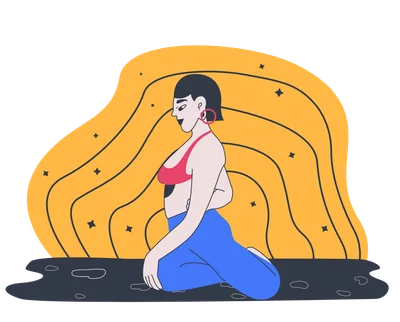
Bharadvaja's Twist (Bharadvajasana 1) opens the chest while the spine rotates inward, and I've watched hundreds of students hit the same wall in that shape. The twist asks the ribs to turn past their comfortable range, and right at that edge, people brace. Shoulders creep up, breath goes shallow, the face tightens. That bracing is the physical signature of defense, the exact thing that happens when you're asked to look honestly at yourself instead of the polished version. Stay there and breathe. Notice where you clench against being seen, even by yourself.

Dem weisen BharadvajaAsanaDem weisen BharadvajaBharadvajasana 1Zur Asana →

Easy Pose (Sukhasana) does something completely different but equally necessary. It gives you a stable, grounded seat, hips settled, spine long, nothing performative about it. You cannot speak your truth from a body that's scattered or anxious, and Sukhasana trains you to find ground before you're asked to find words. I've noticed that students who fidget constantly in this pose are often the ones most disconnected from their own quiet voice. Stillness in the hips precedes stillness in speech.

SchneidersitzAsanaSchneidersitzSukhasanaZur Asana →

Building Inner Honesty Through Stillness

Savasana (Corpse Pose) is where the real work finishes. With nothing to perform and nowhere to hold, the small muscular masks people wear all day, the held jaw, the lifted chin, the readiness to react, finally let go. In that undoing, Satya as inner freedom stops being an idea about honesty and becomes an experience of it: you meet yourself unguarded, without commentary. As one perspective on Satya puts it, wahrhaftigkeit means encountering your own shortcomings without flinching, and Savasana is often the first place students actually manage that.

TotenstellungAsanaTotenstellungSavasanaZur Asana →
Lotuscrafts Meditationsmatte

Lotuscrafts Meditationsmatte

Auf Amazon shoppenPreis: 70

None of this works through effort or willpower. It works through repetition, the felt sense of your own body slowly learning that stillness is safe rather than something to defend against. As that recognition deepens, the split between a defended body and a performing mind closes on its own. That's the quiet, physical engine behind every yama yoga ethik text ever written about Satya: you're not memorizing a virtue, you're teaching your body what truth actually feels like from the inside.

Meeting Yourself Unmasked: Satya as Self-Honesty

Here's the part of Satya nobody puts on a poster: before you can be truthful with anyone else, you have to sit down across from yourself. Not the version you present at work, not the version you perform for your partner, not even the version you privately hope you are. The actual one. The tradition describes this as meeting yourself unadorned and unvarnished, which is a beautiful phrase until you realize what it's actually asking. It's asking you to look at your jealousy, your laziness, your fear of being ordinary, and just... see it. No spin.

The Courage to Face Your Shadow

This is where most people flinch, and honestly, I flinched for years. There's a specific kind of fatigue that comes from maintaining an internal PR campaign about yourself, quietly editing your own memories, explaining away your contradictions before anyone even asks. Satya as a path to inner freedom means you stop doing that unpaid, exhausting job of managing your own image, even inside your own head. The scriptures frame this as courage, and I think that's accurate. It takes nerve to admit you were petty, or scared, or wrong, without immediately building a case for why it wasn't really your fault.

From Judgment to Compassionate Recognition

But here's the distinction that keeps this from turning into self-flagellation: this unmasked self-meeting is recognition, not verdict. Beating yourself up is just another mask, a performance of being someone who takes their flaws very seriously. Honest self-recognition is quieter than that. It says, this is what's true right now, and stops there. Yoga philosophy has never asked you to hate what you find; it asks you to stop denying it exists. That denial is the real cost. You cannot change what you refuse to see, and refusal, dressed up as self-esteem or positivity, is still refusal.

This is why Satya sits underneath every other yama yoga ethik discussion as the prerequisite, not an option among options. Meet reality as it actually is, including your own reality, and something loosens. Not because you've fixed anything yet, but because you've stopped spending energy pretending there's nothing to fix. That's where the actual work of transformation gets to begin.

Satya as a Living Path: From Inner Truth to Authentic Action

You're typing a text message to a friend who hurt you, and the version you almost send is polished, casual, safe. It says "no worries, all good" when nothing is good. Your thumb hovers over send. Then you delete it and write something messier and truer: "that actually stung, can we talk." Nobody's watching this moment. There's no witness, no reward. But something in your nervous system just voted for coherence over comfort, and that vote counts.

The Integration of Thought, Speech, and Deed

Satya doesn't arrive as a lightning bolt of revelation. It arrives in a meeting where someone asks if you understood the brief and you say "actually, no, can you walk me through it again" instead of nodding along. It arrives when you let your voice shake instead of performing certainty you don't feel. These moments feel small, almost forgettable, but they're doing something your conscious mind barely registers: teaching your body that truth is survivable.

This is where yoga philosophy and nervous-system science quietly agree. Every time you choose the truthful response over the convenient one, you're not just making an ethical choice, you're reinforcing a neural pathway. The brain doesn't distinguish between the size of the act and the strength of the wiring. A thousand small truths build the same kind of automaticity as one big dramatic honesty. Authenticity becomes your default not because you decided it once, but because you practiced it constantly.

Satya in Daily Life: Small Acts, Deep Alignment

Look at where you perform rather than exist. Maybe it's the enthusiasm you fake about plans you dread, the confidence you project in rooms where you feel lost, the agreement you voice when you actually disagree. None of these are lies in the dramatic sense. They're just erosion, one polite nod at a time, of the person underneath.

As these micro-practices accumulate, something practical happens: maintaining a mask takes energy, and dropping it gives that energy back. Less effort goes into remembering which version of yourself you showed to whom. More is left over for actual creativity, actual connection, actual rest. This week, pick one place where you've been performing. Send the honest text instead of the polished one. That's the whole practice.

Stillleben: offenes Tagebuch mit Stift, eine Kerze und ein Stein auf heller Textilunterlage, symbolisierend innere Reflexion und tägliche Praxis
Tagebuch und stille Reflexion – praktische Werkzeuge zur Kultivierung von Satya im Alltag

Satya as Gateway: Integrating Truthfulness Into Your Yoga Path

Here's the thread running underneath everything we've covered: Satya was never meant to stand alone on the shelf of yogic ethics, filed neatly between Ahimsa and the rest of the yamas and niyamas. It's the bridge. Ahimsa asks you to stop causing harm, but you can't fully stop harming others while you're still lying to yourself about who you are and what you feel. The moment you get honest, really honest, about your own fear, envy, or anger, you stop projecting it outward as blame or cruelty. Truthfulness disarms violence at its root, because most of the harm we cause comes from the parts of ourselves we refuse to see.

How Satya Supports All Other Yamas

Sat, in Yoga Sutra 2.36, points to the highest truth, and Satya as an inner stance means staying devoted to that truth even when it's inconvenient. That devotion has ripple effects. Asteya, non-stealing, gets easier when you're honest about your own sufficiency instead of grasping for what isn't yours. Brahmacharya, the wise use of your energy, requires the same clear seeing Satya trains. Even Aparigraha, non-attachment, depends on your willingness to admit what you're actually clinging to. Satya isn't one yama among five, it's the clarity that lets the other four actually land.

This is what the yamas as a whole are really pointing at: Satya is the honesty you walk through life with, toward yourself and toward the people around you. Once that honesty is real, ethical living stops being a checklist and starts being coherence. You're not managing five separate rules anymore. You're just aligned.

Finding that honest voice, the one that speaks from real clarity instead of performance, is exactly what the mantra Om Aim Saraswatyai Namaha calls forth: wisdom, clear expression, and a truthful voice that isn't afraid to sound like itself. As a daily reminder there is our Saraswati shirt, so you carry that clarity with you at all times, on the mat and in the middle of an ordinary conversation.

Om Aim Saraswatyai Namaha - The Flow of Knowing (WHITE)

Om Aim Saraswatyai Namaha - The Flow of Knowing (WHITE)

T-Shirt aus der Saraswati-Kollektion. Mantra: Om Aim Saraswatyai Namaha. Weisheit, Kreativität und Lernen — für alle, die ihrer inneren Stimme Ausdruck geben.

Jetzt ansehenPreis: 35

Your Next Step: Begin the Practice

Skip the temptation to overhaul your whole life this week. Pick one practice we've talked about: Bharadvaja's Twist if you want to sit with self-reflection, Sukhasana if you want centered presence, or Savasana if you're ready to meet your essential self with nothing between you and the floor. Practice it for ten days. Set one intention only: deepen your relationship with your own truth. Nothing more.

Notice what shifts, not just on the mat but in how you speak to your partner, how you answer when someone asks how you're doing, how you carry yourself when no one's watching. You don't need to force the other yamas into place. When Satya becomes alive in you, they start arriving on their own, because truthfulness was always the ground the rest of the path was standing on.

Sources & further links

Community

Deine Erfahrungen

Teile deine Erfahrungen mit der Community.

Kommentare werden vor der Veröffentlichung geprüft.